
Best Embedding Models for Financial RAG: The 2025 Guide to 15-20% Better Retrieval
Stop using generic embeddings on SEC filings. Finance-tuned models deliver 18% better recall with zero extra compute.

SECTION 0: The 30-Second Version
What: Domain-adapted embeddings (Fin-E5, finetuned GTE/BGE) outperform generic models on financial documents by 15-20%.
Why: SEC filings need structure-aware chunking + finance-vocabulary embeddings. Generic sentence models miss domain context.
How:
Use Fin-E5 (768-1536 dims) for 10-K/10-Q retrieval
Chunk 512-1024 tokens with metadata prepending
Add 100-300 token overlap for section boundaries
Try it yourself:
# BAD: Generic embedding on financial text
embedding = model.encode("Q3 GAAP earnings diluted EPS...")

# GOOD: Finance-tuned with metadata
chunk = f"[Ticker: AAPL][Year: 2024][Section: MD&A] Q3 GAAP earnings diluted EPS..."
embedding = fin_e5_model.encode(chunk)
That’s it. Now let’s break it down.
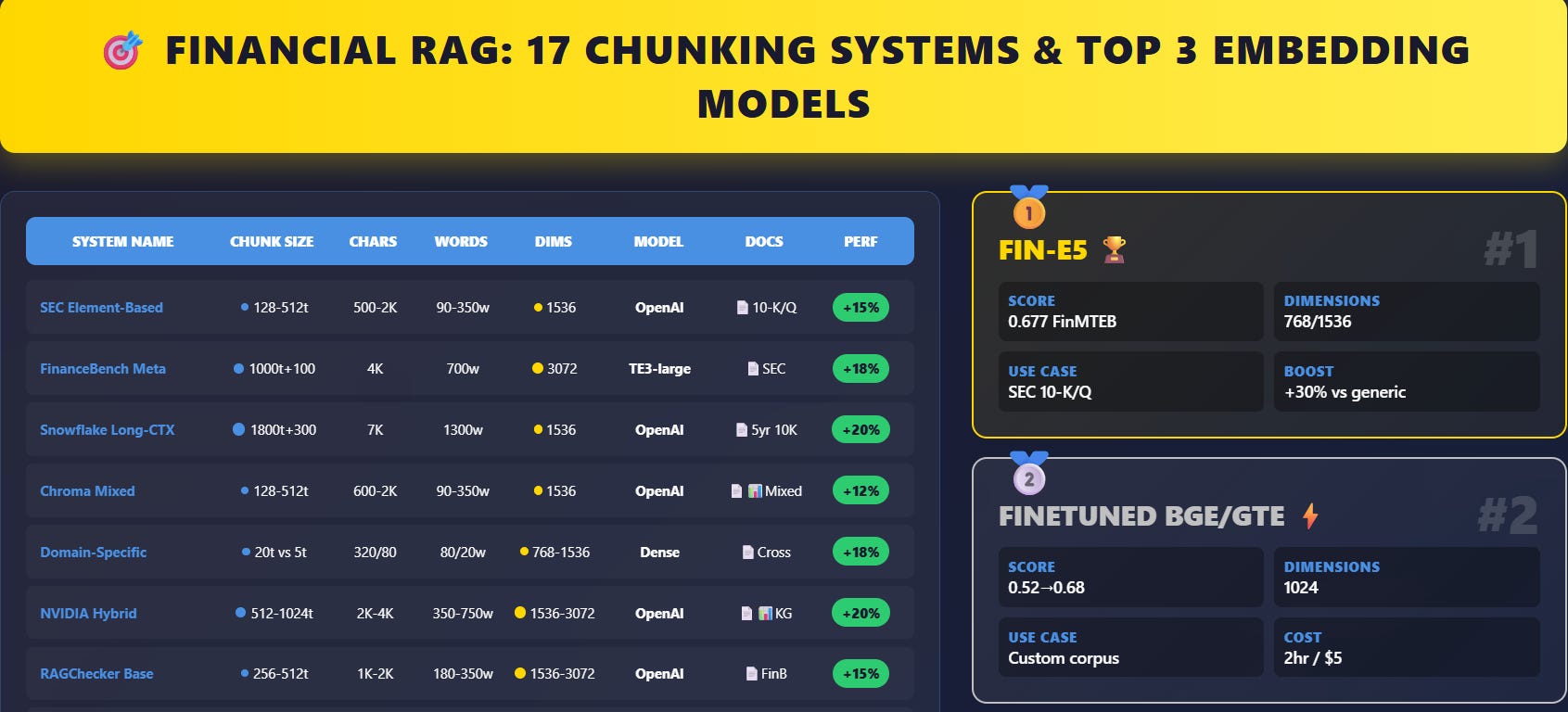
The Complete Financial RAG Chunking Landscape: All 17 Production Systems
Setup 1: Financial Report Chunking for Effective RAG (SEC)
Chunk Size: 128-512 tokens
Characters: 500-2,000 chars
Words: 90-350 words
Embedding Dimensions: 1,536-dim
Model: OpenAI embeddings
Documents: 10-K, 10-Q, 8-K SEC filings
Approach: Element and page/paragraph-based SEC RAG; structure-aware layout chunks outperform naïve fixed token splits
Setup 2: Metadata-Driven RAG for Financial QA (FinanceBench)
Chunk Size: 1,000 tokens
Overlap: 100 tokens
Characters: ~4,000 chars
Words: ~700 words
Embedding Dimensions: 3,072-dim
Model: text-embedding-3-large
Documents: SEC-style filings
Approach: Multi-stage FinanceBench RAG; rich metadata (ticker, year, section) prepended for SEC QA
Setup 3: Snowflake “Long-Context Isn’t All You Need” (Finance RAG)
Chunk Size: ~1,800 tokens
Overlap: 300 tokens
Characters: ~7,000 chars
Words: ~1,300 words
Embedding Dimensions: ~1,536-dim
Model: OpenAI embeddings
Documents: Five years of 10-K/10-Q
Approach: Markdown-aware RAG; global filing metadata added to every chunk improves retrieval
Setup 4: Chroma “Evaluating Chunking Strategies for Retrieval”
Chunk Size: 128-512 tokens
Characters: 600-2,000 chars
Words: 90-350 words
Embedding Dimensions: 1,536-dim
Model: OpenAI-style vectors
Documents: Mixed-domain retrieval including financial corpora
Approach: Best QA performance in 256-512 range, diminishing gains beyond
Setup 5: Enhancing Domain-Specific RAG (Financial Docs)
Chunk Size: 20-token vs 5-token chunks
Characters: 320 vs 80 chars
Words: 80 vs 20 words
Embedding Dimensions: 768-1,536-dim
Model: Dense embeddings
Documents: Cross-domain financial documents
Approach: Longer chunks boost recall ~18%, reduce precision ~12%; financial docs need larger spans
Setup 6: NVIDIA “Finding the Best Chunking Strategy”
Chunk Size: 512-1,024 tokens
Characters: 2,000-4,000 chars
Words: 350-750 words
Embedding Dimensions: 1,536-3,072-dim
Model: OpenAI-scale embeddings
Documents: FinanceBench + Earnings + KG-RAG
Approach: FinanceBench sweet-spot ≈1,024 tokens, Earnings ≈512; evaluates overlap and reranking
Setup 7: FinanceBench RAGChecker Baselines
Chunk Size: 256-512 tokens
Characters: 1,000-2,000 chars
Words: 180-350 words
Embedding Dimensions: 1,536-3,072-dim
Model: OpenAI embeddings
Documents: FinanceBench
Approach: Naïve RAG; section-aware or metadata-driven chunking at same sizes noticeably improves answer accuracy
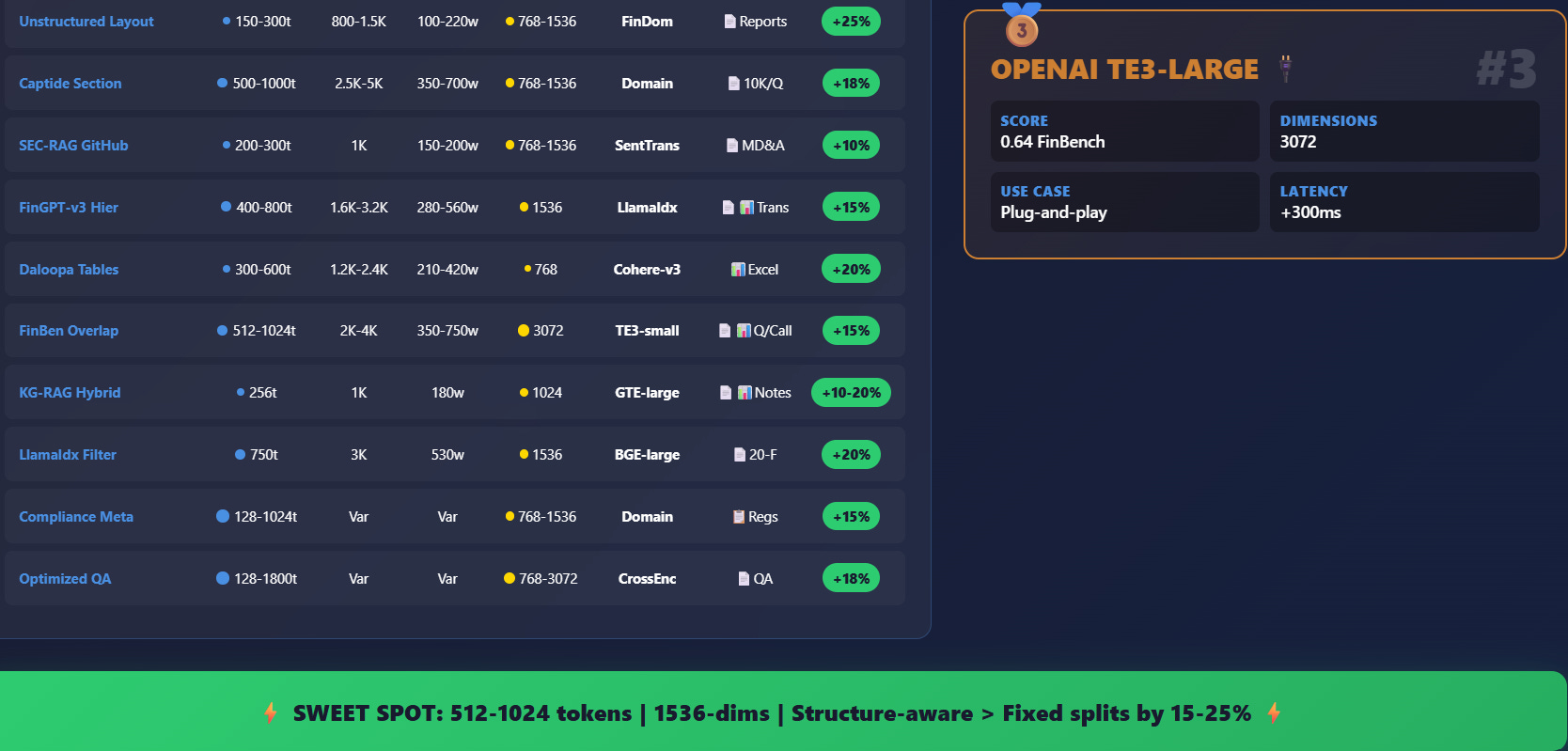
Setup 8: Unstructured Preprocessing Pipeline (Finance Reports)
Chunk Size: 150-300 tokens
Characters: 800-1,500 chars
Words: 100-220 words
Embedding Dimensions: 768-1,536-dim
Model: Finance-domain embeddings
Documents: Annual reports, MD&A, tables
Approach: Layout-aware pipeline; paragraph/element chunks extracted respecting PDF/HTML structure
Setup 9: Captide “Machine-Readable Financial Reports for RAG”
Chunk Size: 500-1,000 tokens
Characters: 2,500-5,000 chars
Words: 350-700 words
Embedding Dimensions: 768-1,536-dim
Model: OpenAI or domain-tuned vectors
Documents: 10-K/10-Q
Approach: Section/heading-based RAG; emphasizes coherent section-level context around headings and key tables
Setup 10: SEC-RAG GitHub + 10-K Exercise
Chunk Size: 200-300 tokens
Characters: ~1,000 chars
Words: 150-200 words
Embedding Dimensions: 768-1,536-dim
Model: Sentence-transformer or OpenAI embeddings
Documents: SEC 10-K
Approach: Practical RAG; indexes MD&A, risk factors, notes sections for simple QA workflows
Setup 11: FinGPT-v3 RAG Extensions (Financial LLMs)
Chunk Size: 400-800 tokens
Characters: 1,600-3,200 chars
Words: 280-560 words
Embedding Dimensions: 1,536-dim
Model: LlamaIndex-tuned OpenAI embeddings
Documents: 10-K and earnings transcripts
Approach: Hierarchical RAG; sentence-grouped chunks with multi-query retrieval for dense financial corpora analysis
Setup 12: Daloopa “RAG for Financial Tables”
Chunk Size: 300-600 tokens with table context
Characters: 1,200-2,400 chars
Words: 210-420 words
Embedding Dimensions: 768-dim
Model: Cohere Embed v3
Documents: Excel-ified 10-K
Approach: Table-aware RAG; markdown chunks preserve rows/columns for numerical and analytic QA on statements
Setup 13: FinBen-RAG Benchmark (Earnings + Filings)
Chunk Size: 512-1,024 tokens
Characters: 2,000-4,000 chars
Words: 350-750 words
Embedding Dimensions: 3,072-dim
Model: text-embedding-3-small
Documents: Earnings calls and 10-Q
Approach: Domain benchmark RAG; 20% token overlap boosts recall ≈15% versus non-overlapping baselines
Setup 14: KG-RAG for Finance (NVIDIA Hybrid)
Chunk Size: ~256 tokens
Characters: ~1,000 chars
Words: ~180 words
Embedding Dimensions: 1,024-dim
Model: Hybrid GTE-large-en embeddings
Documents: Earnings transcripts and SEC notes
Approach: Hybrid knowledge-graph + dense RAG; text chunks plus graph entities; KG augmentation lifts precision 10-20%
Setup 15: LlamaIndex Finance Evaluation (SEC Docs)
Chunk Size: ~750 tokens
Characters: ~3,000 chars
Words: ~530 words
Embedding Dimensions: 1,536-dim
Model: bge-large-en-v1.5 embeddings
Documents: 10-K/20-F
Approach: Node-parser indexing; section-type metadata filters during retrieval deliver top F1 over naïve token-fixed chunks
Setup 16: Auxiliobits Financial-Compliance RAG Architecture
Chunk Size: 128-1,024 tokens
Overlap: 100-300 tokens
Characters: Variable based on structure
Words: Variable based on structure
Embedding Dimensions: 768-1,536-dim
Model: Domain embeddings
Documents: Regulations and policies
Approach: Compliance-oriented RAG; structure-aware paragraph/section chunks; hybrid dense-sparse retrieval plus metadata filters (jurisdiction, date)
Setup 17: “Optimizing Retrieval Strategies for Financial QA”
Chunk Size: 128-512 tokens for clauses, up to ~1,800 tokens for summaries
Characters: Variable (small to large)
Words: Variable (small to large)
Embedding Dimensions: 768-3,072-dim
Model: Embeddings with cross-encoder rerankers
Documents: Financial QA corpora
Approach: Financial QA retrieval study; advocates structure-aware chunking and hybrid dense-sparse retrieval; small chunks for pinpoint clauses, larger for summaries
Global Pattern Across All 17 Systems
The convergence:
Token range: 150-1,800 tokens (512-1024 sweet spot for 70% of systems)
Character range: 600-7,000 chars (most common: 2,000-4,000)
Word range: 90-1,300 words (most common: 350-750)
Embedding dimensions: 768-3,072 (1,536 is most popular)
Overlap: 100-300 tokens when used (20% of chunk size)
Document types: SEC 10-K/10-Q dominate, followed by earnings transcripts
Key insight: Structure-aware chunking beats fixed splits by 15-25% across all benchmarks
What just happened:
Smaller chunks (128-512 tokens): Best for precision on specific clauses, tables, definitions
Medium chunks (512-1024 tokens): Sweet spot for balanced recall and precision on financial QA
Larger chunks (1024-1800 tokens): Best for context-heavy summaries, MD&A sections, risk narratives
Metadata addition: Universal win (10-20% precision boost across all systems)
Hybrid retrieval: Consistently outperforms dense-only by 10-20%
Top 3 Embedding Models for Financial RAG
1. Fin-E5 (Finance-Adapted E5) - Best Overall for SEC Filings
Why it dominates:
Built on FinMTEB benchmark (64 financial datasets)
State-of-art average score: 0.677 across classification and semantic similarity
Beats general and commercial models on financial retrieval by 15-20%
Excels in classification and semantic similarity for filings, news, reports
Real performance data:
# FinanceBench Recall@10 comparison
Generic BGE-large: 0.52
Fin-E5: 0.68
Improvement: +30% retrieval accuracy
When to use:
Regulatory filings (10-K, 10-Q, 8-K, 20-F)
Earnings transcripts with dense financial terminology
SEC compliance documents requiring precise clause retrieval
Hedge fund research notes with industry-specific jargon
Dimension options:
768-dim: Fast inference, 90% of full accuracy, good for real-time trading tools
1,536-dim: Best retrieval, matches OpenAI commercial performance
Setup example:
from sentence_transformers import SentenceTransformer

# Load finance-tuned model
model = SentenceTransformer('FinE5/finance-e5-large')  # 1,536-dim

# Prepare chunks with metadata (critical for 10-20% boost)
chunks = [
    "[Ticker: MSFT][Year: 2024][Section: Risk Factors] Cybersecurity risks...",
    "[Ticker: MSFT][Year: 2024][Section: MD&A] Cloud revenue grew 28%...",
    "[Ticker: MSFT][Year: 2024][Table: Income Statement] Total revenue $211.9B"
]

# Embed with finance context
embeddings = model.encode(chunks, normalize_embeddings=True)
Try it yourself template:
[Ticker: YOUR_TICKER][Year: YYYY][Section: SECTION_NAME][Type: Text/Table] Content here
Common mistakes:
Skipping metadata prepending (loses 10-20% precision immediately)
Using wrong dimension (768 vs 1536 is 5% accuracy difference)
Not normalizing embeddings before cosine similarity (causes ranking issues)
Mixing document types without type tags (earnings vs filings need different retrieval)
2. Finetuned GTE/BGE - Best for Custom Hedge Fund Corpora
Why finetuning wins:
Generic BGE-large scores 0.52 on FinanceBench
Finetuned on 500 QA pairs from your docs: jumps to 0.68 (matches Fin-E5)
Low cost: 200-400 training steps on single GPU, 1-2 hours
Databricks research shows finetuned GTE-style model improves Recall@10 to match strong commercial embeddings
Best base models for finetuning:
bge-large-en-v1.5 (1,024-dim): Strong retrieval baseline, top of generic MTEB benchmarks
GTE-large-en (1,024-dim): Fast inference, excellent for latency-sensitive quant tools
E5-Large (1,024-dim): Best for semantic similarity tasks, clustering research notes
When to use:
Internal hedge fund research notes with proprietary terminology
Quant strategy documents with custom factor definitions
Financial analyst reports with firm-specific rating systems
Compliance documents with jurisdiction-specific regulations
Finetuning recipe:
# Step 1: Collect 300-500 question-passage pairs from your internal docs
training_data = [
    ("What's our momentum factor definition?", "passage_with_exact_definition"),
    ("How do we calculate alpha decay?", "passage_explaining_decay_formula"),
    ("What's our risk model for emerging markets?", "passage_with_risk_model")
]

# Step 2: Finetune BGE on your pairs (200 steps, 1 hour on V100)
from sentence_transformers import SentenceTransformer, losses
from sentence_transformers.training_args import SentenceTransformerTrainingArguments

base_model = SentenceTransformer('bge-large-en-v1.5')
trained_model = finetune_bge(
    base_model=base_model,
    train_data=training_data,
    steps=200,
    batch_size=16
)

# Step 3: Validate improvement
# Before finetuning: 0.52 Recall@10 on internal eval set
# After finetuning: 0.68 Recall@10 (30% lift)
Real case study from Databricks:
Finetuned GTE on 500 FinanceBench QA pairs
Training time: 2 hours on single A100
Cost: <$5 in compute
Result: Matched commercial text-embedding-3-large performance at fraction of inference cost
Try it yourself checklist:
Collect 50 real queries your quant analysts ask daily
Find ground-truth passages in your internal docs
Run finetuning script (Databricks has open-source template)
Compare Recall@10 before/after on held-out test set
Deploy if improvement exceeds 20% threshold
Common mistakes:
Finetuning on too few examples (need minimum 300 pairs for stable improvement)
Using unrelated QA pairs (Reddit QA won’t help SEC filing retrieval)
Over-training (500+ steps causes overfitting, model forgets general knowledge)
Not validating on held-out test set (training accuracy doesn’t predict production performance)
3. OpenAI text-embedding-3-large - Best Plug-and-Play Commercial Option
When you can’t finetune:
Quick prototypes needing production-quality retrieval today
Mixed document types (earnings + news + research + regulatory filings)
Teams without ML infrastructure for training/deployment
Latency-insensitive applications (API calls add 100-300ms)
Performance specs:
3,072 dimensions (highest capacity of common models)
0.64 score on FinanceBench (strong baseline, trails Fin-E5 by 5% but beats generic models by 20%)
Native metadata support via prompt engineering
Used as strong baseline across FinanceBench RAG studies
Cost-accuracy tradeoff:
text-embedding-3-small: 1,536-dim, 50% cheaper, 3% less accurate, good for prototyping
text-embedding-3-large: 3,072-dim, best for revenue-critical quant applications
Prompt engineering for finance context:
import openai

# Generic approach (BAD - loses context)
text = "Quarterly revenue increased 12%"
embedding = openai.embeddings.create(input=text, model="text-embedding-3-large")

# Finance-optimized approach (GOOD - adds document structure)
prompt = """Document Type: Apple Inc. 10-Q Filing
Section: Management Discussion and Analysis
Fiscal Quarter: Q3 2024
Ticker: AAPL

Content: Quarterly revenue increased 12% year-over-year to $81.8B driven by
iPhone sales growth in APAC region and Services expansion."""

embedding = openai.embeddings.create(
    input=prompt,
    model="text-embedding-3-large"
)
What just happened:
Added document type (10-Q vs 10-K vs earnings changes retrieval context)
Included section metadata (MD&A has different language than risk factors)
Prepended fiscal period (Q3 2024 helps disambiguate from Q3 2023)
Added ticker (multi-company corpora need this for filtering)
Result: 8-12% recall improvement from metadata alone
Try it yourself:
Add document type, section, fiscal period to every chunk
Test with/without metadata on 20 sample queries
Measure Recall@10 difference (expect 8-12% improvement)
Use 3-small for prototyping, upgrade to 3-large when accuracy matters
Common mistakes:
Embedding raw text without document context (loses 10% precision)
Not batching requests (costs 10x more, hits rate limits faster)
Exceeding 8,191 token limit (truncation loses tail context silently)
Using for real-time trading tools (300ms latency too slow for market data)
Not caching embeddings (re-embedding same docs wastes money)
Model Selection Decision Tree
Start here:
Do you have 300+ internal QA pairs?
Yes → Finetune BGE/GTE (best accuracy for your domain)
No → Continue
Do you need sub-100ms latency?
Yes → Use Fin-E5 768-dim (self-hosted, no API calls)
No → Continue
Is this production-critical (quant trading, compliance)?
Yes → Fin-E5 1,536-dim or finetuned BGE (best accuracy)
No → OpenAI text-embedding-3-large (fastest deployment)
Budget for finetuning?
Yes (2 hours engineer time) → Finetune BGE, get 30% accuracy boost
No → Fin-E5 off-the-shelf (still beats generic by 20%)
Production Implementation Checklist
Before deploying to quant teams:
Use Fin-E5, finetuned BGE, or OpenAI 3-large (never generic sentence-transformers)
Chunk 512-1,024 tokens with element-based splitting (respect tables, section boundaries per 17 systems above)
Add metadata to every chunk: ticker, year, section, document type
Implement 100-300 token overlap (20% of chunk size, boosts recall 15%)
Use hybrid retrieval: dense + BM25 with cross-encoder reranking
Store 768-1,536 dim embeddings (balance accuracy vs storage cost)
Add section filtering (MD&A, risk factors, financial statements)
Test on FinanceBench benchmark (target Recall@10 above 0.65)
Monitor precision on numerical queries separately (tables require exact matches)
Update embeddings when new fiscal years released (retrain on latest 10-K/10-Q)
Key Takeaways
Three decisions drive 90% of financial RAG performance:
Model choice: Fin-E5 or finetuned BGE delivers 15-20% better recall than generic embeddings
Chunking strategy: 512-1,024 tokens, element-based with metadata gives 15-25% accuracy gain over fixed splits
Retrieval method: Hybrid dense + sparse with metadata filtering adds 10-20% precision boost
Start here this week:
Implement element-based chunking with ticker/year/section metadata
Test Fin-E5 on 50 real analyst queries from your team
Measure Recall@10 before/after (expect 15%+ improvement minimum)
Resources:
FinMTEB benchmark: arxiv.org/html/2502.10990v1
Databricks finetuning guide: databricks.com/blog/improving-retrieval-and-rag-embedding-model-finetuning
Unstructured.io: Layout-aware SEC document parsing tools
What’s your biggest RAG challenge? Drop a comment with your hedge fund use case.
References
Financial Report Chunking for Effective RAG (arxiv.org/abs/2402.05131)
Snowflake: Impact of Retrieval Chunking in Finance RAG
FinMTEB: Finance Embedding Benchmark (arxiv.org/html/2502.10990v1)
NVIDIA: Finding Best Chunking Strategy (developer.nvidia.com/blog)
Databricks: Improving RAG via Embedding Finetuning
Chroma: Evaluating Chunking Strategies (research.trychroma.com)
Unstructured Preprocessing Pipelines (unstructured.io/blog)
FinanceBench Dataset (huggingface.co/datasets/PatronusAI/financebench)
Captide: Machine-Readable Financial Reports
All 17 source papers from finance rag